











Offshore / Onsite
Hire Dedicated Team
Access a dedicated team of engineers and QA, on-site or remote, focused on your product and your roadmap.
Get StartedAPI development in REST and GraphQL, with idempotency and retries on every write, versioning with a deprecation window in writing, and docs partners can self-serve against. Integrations with the systems nobody documented are most of the actual work.
Our Clients

















API projects rarely overrun on the endpoints. They overrun on the four things nobody scoped: the undocumented system, the retry that charged twice, the version nobody could deprecate, and the partner who could not get started without a phone call.
Client and server teams both wait, then integrate in the last two weeks and discover they modelled the same thing differently.
An OpenAPI or GraphQL schema agreed and mocked in week one, so both sides build against the same thing in parallel.
A timeout triggers a retry, the retry succeeds, and a customer is charged twice. Found in production, by the customer.
Idempotency keys on every write, with replay tests that fire the same request repeatedly and assert one effect.
A breaking change is needed, no consumer inventory exists, and the old version runs forever because nobody knows who uses it.
Versioning from v1, consumer tracking per key, and a written deprecation window with usage-based sunset notices.
Every partner integration starts with a call, an email thread and a manually issued key. Adoption is bounded by your calendar.
Generated reference from the spec, a runnable sandbox and self-serve keys, so a partner integrates without speaking to anyone.
The endpoints are the easy half. These six are what make an API something other teams can actually build on.
OpenAPI or GraphQL schema agreed first, generating server validation, client SDKs and docs, so drift between them becomes impossible rather than likely.
Keys on every mutating operation, defined retry behaviour, and tests that replay requests to prove exactly one effect occurs.
Versioning strategy, consumer tracking per API key, and a written support window so a sunset is a process rather than an argument.
OAuth or key-based auth with granular scopes, per-consumer quotas, and limits that return useful headers rather than a bare 429.
Generated reference docs, a sandbox with seeded data, self-serve keys and copy-paste examples in the languages your partners actually use.
Signed payloads, at-least-once delivery, exponential backoff, a replay endpoint and a delivery log consumers can inspect themselves.
The moment an API has consumers outside your team, the contract and the deprecation policy matter more than the implementation.
Where adoption depends on a developer succeeding alone at midnight without contacting your team.
Shared services several squads build on, where a breaking change becomes four teams’ sprint planning.
Middleware between systems that were never designed to talk — usually including one with no documentation and one owner who left.
Where old app versions persist for months and the API has to tolerate every build still in the wild.
Outbound events partners rely on, where a silent delivery failure damages trust more than an outage.
Putting a clean, documented contract in front of something old, so new work stops inheriting its shape.
API development is unusually mechanical once the contract exists: handlers per endpoint, validation schemas, client SDKs in four languages, integration tests per status code, example payloads. Generating that from the spec collapses weeks of typing into hours, and the recovered budget goes into the integration archaeology and failure semantics that actually decide whether the API holds.
Server handlers, validation, client libraries and typed models generated from the contract in every language your consumers use. Hand-writing four SDKs is weeks of work with no thinking in it.
Integration tests generated across success, validation failure, auth failure, rate limit and timeout for every endpoint. Previously the coverage that got trimmed when the sprint tightened.
Existing code, database schemas and network traces read to work out what an undocumented service actually does. This is normally the single largest unknown in an integration estimate.
What the resource model should be, how a partial failure behaves and what a deprecation window commits you to are consequential decisions made by senior engineers. Efficiency on the surrounding volume is what makes room for that thinking.
See our AI practiceResource modelling, naming and versioning strategy are deliberate decisions reviewed with your team before any code exists.
Generated coverage is a floor. An engineer writes the replay cases specific to your money paths and confirms exactly one effect.
Anything inferred from old code is confirmed by observing real traffic before it becomes a documented behaviour.
Generated code passes identical contract tests, security scanning and review. Provenance never lowers the standard.
A contract agreed and mocked immediately lets client and server teams work in parallel rather than in sequence. That alone usually removes a fortnight from the timeline and all of the last-minute integration panic.
Resources, operations, error shapes and pagination agreed with everyone who will consume it, then published as a running mock. Consumers start immediately instead of waiting.
The systems this has to talk to, including the undocumented one. Observing real traffic beats trusting a diagram nobody has updated in three years.
Idempotency, retries, timeouts and partial-failure behaviour built with the first endpoint rather than added later. Retrofitting idempotency means auditing every write.
Generated reference, a sandbox with realistic seeded data, and self-serve key issuance. Adoption should not be limited by your team’s availability.
Usage and error rates per consumer, alerting on the paths that matter, and the deprecation policy written down before the first version needs replacing.
Contract-first tooling in your repositories, with the gateway and observability running in your cloud accounts.



Contract-first tooling in your repositories, with the gateway and observability running in your cloud accounts.






Contract-first tooling in your repositories, with the gateway and observability running in your cloud accounts.



Contract-first tooling in your repositories, with the gateway and observability running in your cloud accounts.



Contract-first tooling in your repositories, with the gateway and observability running in your cloud accounts.


Case Studies
Selected work for retail, banking, telecom and defence teams, from brand identity and mobile apps to data platforms and AI assistants.
Panda
Reworked search, categories and checkout in Panda’s live app and website, in Arabic and English.
EDGE Group
Brand identity, website and print for a group of 12,000 staff, carried onto the IDEX show floor.
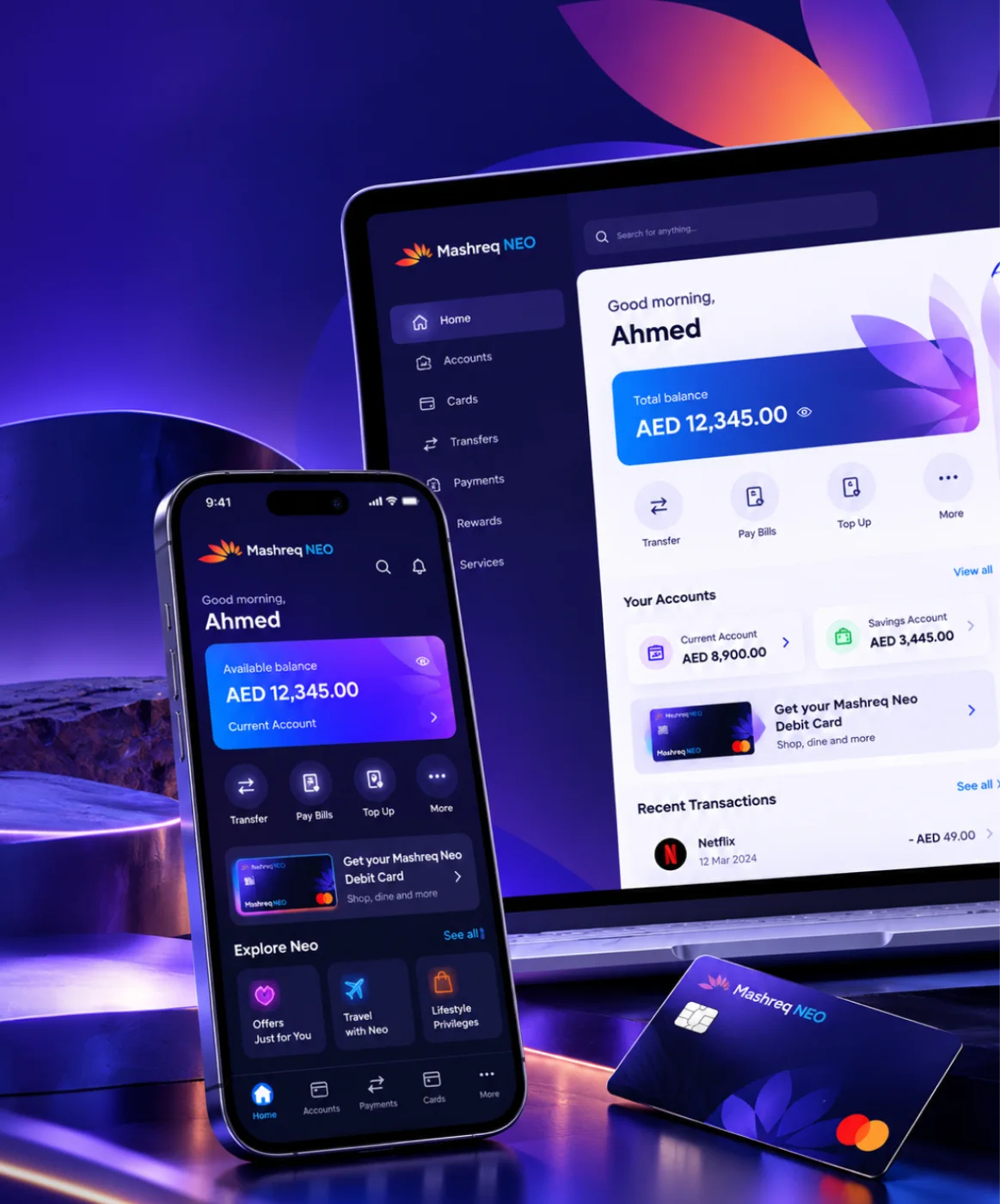
Mashreq NEO
Six performance areas in one index for leadership, plus NEO GPT, a private assistant for bank documents.
Brands For Less
Found where shoppers dropped off, then redesigned sign-up, banners and cart for a retailer with 120+ stores.
Omantel
Incident, SLA and workload reporting in one Power BI suite for Oman’s first telecom operator.




Client Testimonials
Client Success: Panda
We reworked Panda's live app and website, from search to checkout, for shoppers across Saudi Arabia.
"Thanks to UIUX Studio’s work, the client successfully launched their websites. The team maintained a professional approach and scheduled frequent in-person meetings to provide suggestions for improving the project and ensuring its timely delivery."
 Shreya LadCEO, Nutroponics
"The team is well-versed in the UI/UX domain and has designed a fantastic journey to support the site’s growth projection. Communication, timeliness, and quality of work have been very professional."
 Mohammed AbdullahZeaara.com
"The Studio has been an absolute game changer for us. After working on a few independent projects, they are now also helping our marketing team, proving their value to our business and earning praise from executives."
 BrandonProject Manager
"The UIUX Studio team consistently delivers exceptional work with dedication. We’ve completed an amazing app design together, and I’m excited to collaborate with them again in the future."
 Hani Farajvancouverhousefinders.com
"We are really pleased with the work that UIUX Studio team has completed for us in designing a website for a new brand. They completed the designs quickly, took on board changes, and the finished product is very professional."
 AnayaHead of Marketing, Freshminds
"I’ve worked with UIUX Studio team on two projects. They capture the vision and run with it! They create exceptional design! Couldn’t be happier with the quality work and files for my developers."
 Brandon PugmirePresident, Imprint City
 Client Results
Reviewed on Upwork, Trustpilot, Clutch, G2 and GoodFirms





Work With Us
UIUX Studio offers flexible software development services with dedicated teams to meet your business needs. Whether you need an end-to-end build or specialised engineering expertise, our engagement models give you the support to launch and scale.
Access a dedicated team of engineers and QA, on-site or remote, focused on your product and your roadmap.
Get StartedGet clear, upfront pricing for a defined build, such as an MVP, an integration or a platform migration.
Get StartedGet expert engineers by the hour, perfect for code reviews, bug fixes, small features or architecture advice without a long-term commitment.
Get StartedRequest counts tell you about traffic. These tell you whether the API is dependable enough to build on.
Not the average. Consumers experience the tail, and it is the tail that breaks their timeouts.
Broken out per API key, so a single partner integrating badly is visible instead of being averaged away.
Delivered on first attempt versus after retry versus dead-lettered. Silent delivery failure erodes trust faster than downtime.
How often a replayed key is caught. Rising numbers indicate consumer retry storms worth investigating.
Traffic per version and per consumer, which is what makes a deprecation a plan rather than a hope.
How long a new consumer takes from key issuance to a working request. The clearest measure of developer experience.
From retail apps and banking dashboards to a defence group rebrand, we bring proven domain knowledge to every product we design and build.
Talk to Our Team
Streaming, OTT & content platforms

Fan engagement & live data

EdTech & learning platforms

AdTech & campaign tooling

PropTech & marketplaces

Payments, banking & wealth

Digital health & patient apps

Retail & D2C platforms

Supply chain & fleet ops

B2B products & dashboards
APIs sit between things, so this work is almost always scoped alongside whatever is on either side of it.
The client typed against the same contract, so drift becomes a build failure rather than an incident.
View service ↗Gateway, environments and the per-consumer observability the API needs to be operable.
View service ↗Wrapping legacy systems in a clean contract so new work stops inheriting their shape.
View service ↗Contract testing, penetration testing and the auth review a public API requires.
View service ↗Forty-five minutes with a senior engineer. We will tell you where the contract is ambiguous, which writes are unsafe to retry, and what the undocumented system is likely to cost you. No deck, no discovery fee.
Scope an API buildBook a free consultation with our design, engineering and AI experts. Share your idea and we’ll come back within one business day with clear next steps.
Recognised By


Our Offices

UAE · Headquarters
Office OFF2-127, SMARK 2 Building, Plot No. 33-0, Ras Al Khor Industrial Second, Dubai, UAE

India
B-409, Bestech Business Tower, Sector 66, SAS Nagar, Punjab 160062

Australia
Tapleys Hill Road, Fulham Gardens, SA 5024