






Offshore / Onsite
Hire Dedicated Team
Access a dedicated team of engineers and QA, on-site or remote, focused on your product and your roadmap.
Get StartedLegacy platform modernisation: systems mapped before anything is touched, then replaced piece by piece rather than rewritten. Data migrated with parallel running, interfaces kept stable through the move, and retraining avoided wherever the workflow still works.
Our Clients

















A full rewrite asks you to freeze the business for two quarters, reproduce behaviour nobody documented, and switch everything on one weekend. Most fail, and the ones that succeed usually deliver later and thinner than promised.
The business cannot stop for two quarters, so features get added to the old system and the new one falls behind before launch.
Both run together. New work goes into the new system, the old one keeps serving what has not moved yet.
Twenty years of undocumented edge cases, one of which is how a major customer is billed. Nobody finds out until cutover.
Behaviour observed from real traffic and data before it is reimplemented, with the surprises found while they are cheap.
Something fails at 2am, the rollback was never tested, and the decision becomes whether to press on or lose the weekend.
Route a slice of traffic, verify, expand. Every step reversible in minutes without a war room.
The new interface is objectively better and universally hated, because eight hundred people had ten years of muscle memory.
Workflows preserved where they work. We change the interface where it helps, not everywhere it is possible.
The new system is the visible half. The other half is knowing what the old one actually does, which is where most of the risk lives.
Every route, integration, scheduled job and undocumented behaviour, established from the code and from real traffic rather than from a diagram nobody updated.
Which slice moves first and why, with each step delivering value on its own so the programme survives a change of priorities.
A boundary between old and new so the legacy data model stops propagating into everything you build next.
Dual writes or change capture, reconciliation reports, and a period where both systems agree before anything is switched off.
APIs and integrations kept working, so downstream consumers and partners are not dragged into your migration.
What gets switched off, when, and how you prove nothing still depends on it. Most modernisations quietly keep paying for the old system.
The pattern is always the same: the system works, but changing it has become slow, expensive or frightening enough to hold the business back.
Every change carries unknown risk, so changes stop happening and the backlog becomes a list of things nobody will attempt.
A framework, runtime or database version is losing support, which turns modernisation from a choice into a deadline.
The stack narrows your candidate pool, and the people who understand it are the ones you cannot afford to lose.
A system deployed separately per client, where every change is multiplied by the number of installations.
Audit trails, access control or data residency are impossible in the current architecture rather than merely missing.
The infrastructure bill grows faster than usage, and the architecture is the reason rather than the traffic.
The most expensive part of modernisation has always been archaeology: reading hundreds of thousands of lines to work out what a system does, cataloguing every branch, then reimplementing it. Models read code at a volume no team can afford to, which turns a discovery phase measured in months into one measured in weeks and makes the whole programme cheaper to justify.
Legacy code analysed to extract business rules, branch conditions and data flows into documentation your team can review. This is normally the single largest unknown in a modernisation estimate.
Characterisation tests generated against the existing system from real inputs and outputs, so the new implementation is provably equivalent rather than hopefully so.
Repetitive translation and transformation across hundreds of files applied uniformly, where doing it by hand invites inconsistency and fatigue over months.
A rule read out of old code is a hypothesis until it is verified against real traffic and with the people who know the business. Nothing is reimplemented on the basis that a model said the code appeared to do it.
See our AI practiceBusiness logic inferred from code is confirmed against production behaviour and with your domain experts before it is rebuilt.
Generated tests prove equivalence only if they are correct. An engineer reviews them and adds the cases the old system handles by accident.
We read the legacy system to understand it. Changes are made through your normal review process, never automatically.
A shorter discovery phase is priced in rather than pocketed. It is the main reason modernisation is more affordable than it was.
Every step has to be worth doing on its own. That way a change in priorities pauses the programme rather than wasting it, which is the difference between modernisation and a stalled rewrite.
Routes, jobs, integrations and business rules established from the code and from observed traffic. The scheduled job nobody remembers is the one that breaks a cutover.
Which slice moves first, chosen on risk and value rather than on what is technically tidiest. Each step must deliver something on its own.
A facade in front of the legacy system so new work stops inheriting its data model, and traffic can be routed per slice without the caller knowing.
Each slice built, run in parallel, reconciled against the old system, then switched over for a cohort at a time. Reversible in minutes at every point.
Prove nothing still calls the old path, then switch it off and stop paying for it. Programmes that skip this end up maintaining both systems indefinitely.
Reading tools for the old system, ordinary engineering tooling for the new one, and enough observability to prove the two agree.




Reading tools for the old system, ordinary engineering tooling for the new one, and enough observability to prove the two agree.


Reading tools for the old system, ordinary engineering tooling for the new one, and enough observability to prove the two agree.




Reading tools for the old system, ordinary engineering tooling for the new one, and enough observability to prove the two agree.


Reading tools for the old system, ordinary engineering tooling for the new one, and enough observability to prove the two agree.




Case Studies
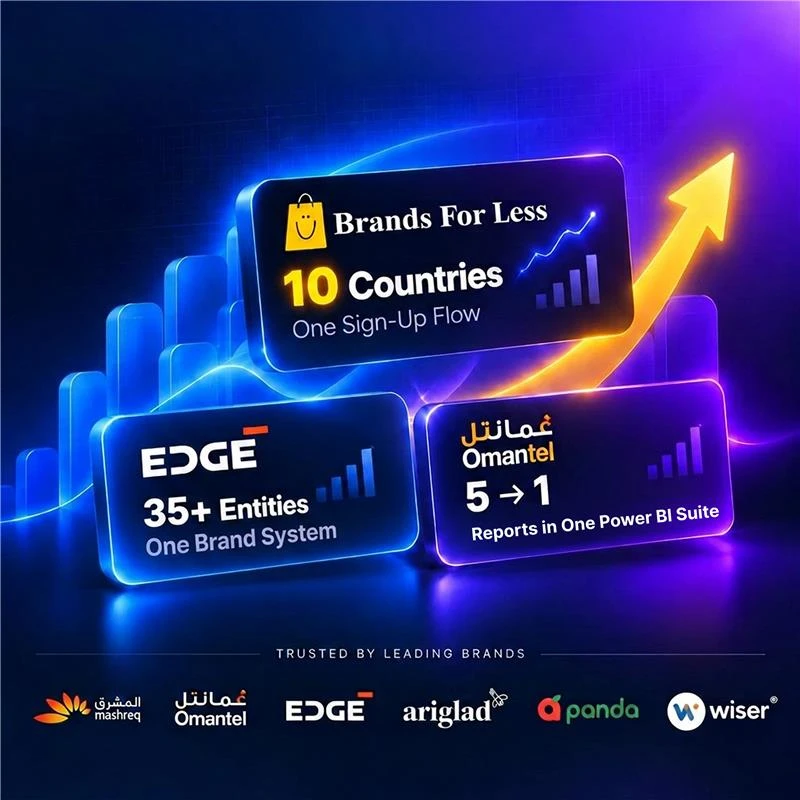
Selected work for retail, banking, telecom and defence teams, from brand identity and mobile apps to data platforms and AI assistants.
Panda
Reworked search, categories and checkout in Panda’s live app and website, in Arabic and English.
EDGE Group
Brand identity, website and print for a group of 12,000 staff, carried onto the IDEX show floor.
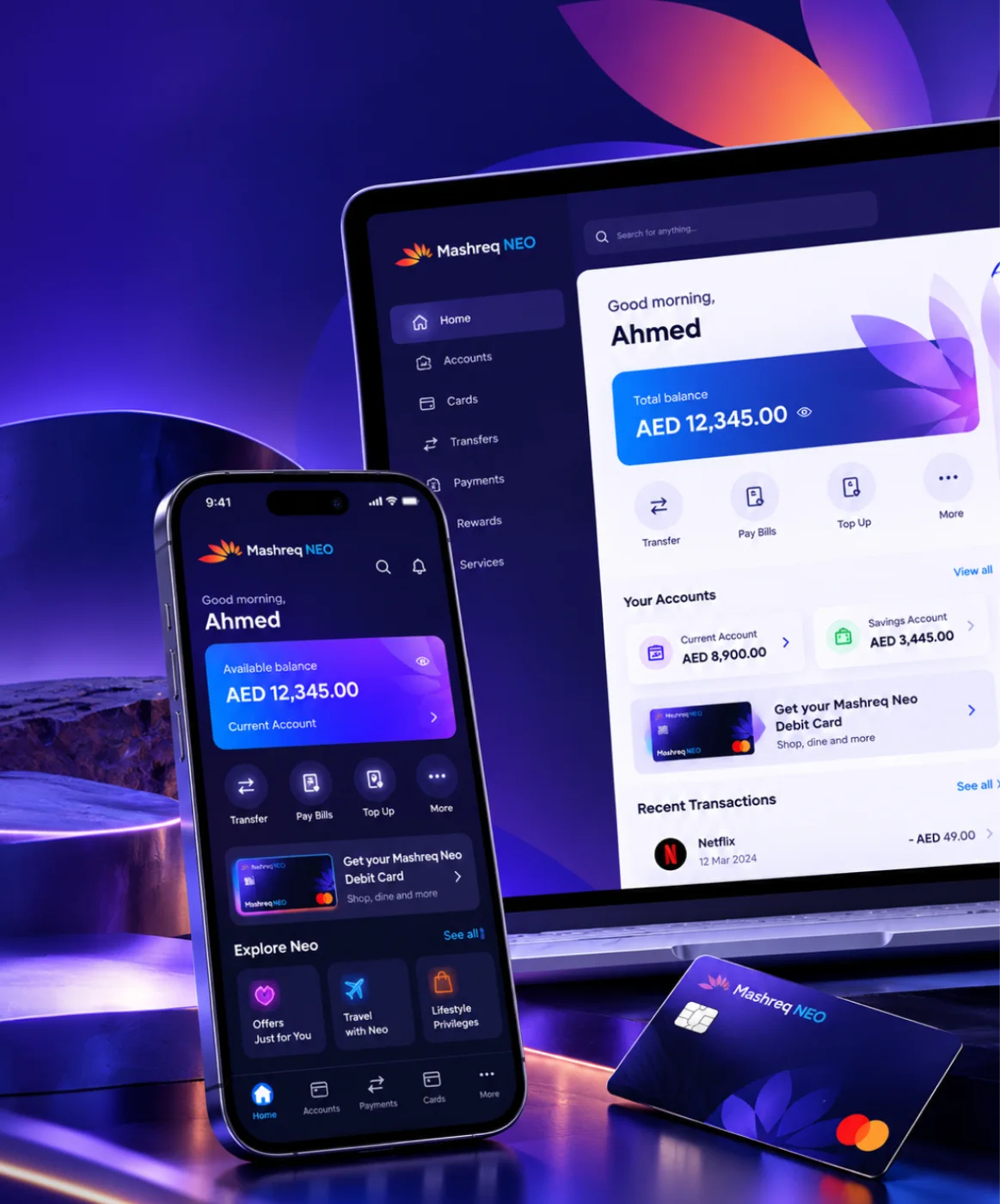
Mashreq NEO
Six performance areas in one index for leadership, plus NEO GPT, a private assistant for bank documents.
Brands For Less
Found where shoppers dropped off, then redesigned sign-up, banners and cart for a retailer with 120+ stores.
Omantel
Incident, SLA and workload reporting in one Power BI suite for Oman’s first telecom operator.




Client Testimonials
Client Success: Panda
We reworked Panda's live app and website, from search to checkout, for shoppers across Saudi Arabia.
"Thanks to UIUX Studio’s work, the client successfully launched their websites. The team maintained a professional approach and scheduled frequent in-person meetings to provide suggestions for improving the project and ensuring its timely delivery."
 Shreya LadCEO, Nutroponics
"The team is well-versed in the UI/UX domain and has designed a fantastic journey to support the site’s growth projection. Communication, timeliness, and quality of work have been very professional."
 Mohammed AbdullahZeaara.com
"The Studio has been an absolute game changer for us. After working on a few independent projects, they are now also helping our marketing team, proving their value to our business and earning praise from executives."
 BrandonProject Manager
"The UIUX Studio team consistently delivers exceptional work with dedication. We’ve completed an amazing app design together, and I’m excited to collaborate with them again in the future."
 Hani Farajvancouverhousefinders.com
"We are really pleased with the work that UIUX Studio team has completed for us in designing a website for a new brand. They completed the designs quickly, took on board changes, and the finished product is very professional."
 AnayaHead of Marketing, Freshminds
"I’ve worked with UIUX Studio team on two projects. They capture the vision and run with it! They create exceptional design! Couldn’t be happier with the quality work and files for my developers."
 Brandon PugmirePresident, Imprint City
 Client Results
Reviewed on Upwork, Trustpilot, Clutch, G2 and GoodFirms





Work With Us
UIUX Studio offers flexible software development services with dedicated teams to meet your business needs. Whether you need an end-to-end build or specialised engineering expertise, our engagement models give you the support to launch and scale.
Access a dedicated team of engineers and QA, on-site or remote, focused on your product and your roadmap.
Get StartedGet clear, upfront pricing for a defined build, such as an MVP, an integration or a platform migration.
Get StartedGet expert engineers by the hour, perfect for code reviews, bug fixes, small features or architecture advice without a long-term commitment.
Get StartedPercentage-complete is the least useful number in a modernisation. These tell you whether it is genuinely working.
Share of real requests served by new code. The only honest measure of progress, and it cannot be fudged.
Disagreements between old and new during parallel running. Has to reach near zero before any cutover.
How long a change takes now versus at the start. The whole point is making the system cheap to change again.
Infrastructure and licence spend on the old system. If it is not falling, decommissioning is being skipped.
Tracked separately from ordinary incidents, so the risk of the programme is visible rather than absorbed.
Old paths actually switched off, not merely bypassed. Bypassed code keeps costing money and confusing people.
From retail apps and banking dashboards to a defence group rebrand, we bring proven domain knowledge to every product we design and build.
Talk to Our Team
Streaming, OTT & content platforms

Fan engagement & live data

EdTech & learning platforms

AdTech & campaign tooling

PropTech & marketplaces

Payments, banking & wealth

Digital health & patient apps

Retail & D2C platforms

Supply chain & fleet ops
B2B products & dashboards
Modernisation touches infrastructure, data and contracts at once, so it is rarely a single-discipline engagement.
The anti-corruption layer and stable contracts that keep consumers out of your migration.
View service ↗Migration pipelines, change capture and the reconciliation reporting parallel running depends on.
View service ↗New infrastructure in code, traffic routing and the observability that proves both systems agree.
View service ↗Where the question is whether to modernise at all, assessed independently under technology advisory.
View service ↗Forty-five minutes with a senior engineer. We will tell you whether the problem is the platform or three specific things, what the first slice should be, and whether modernising is worth it at all. No deck, no audit fee.
Assess your legacy stackBook a free consultation with our design, engineering and AI experts. Share your idea and we’ll come back within one business day with clear next steps.
Recognised By


Our Offices

UAE · Headquarters
Office OFF2-127, SMARK 2 Building, Plot No. 33-0, Ras Al Khor Industrial Second, Dubai, UAE

India
B-409, Bestech Business Tower, Sector 66, SAS Nagar, Punjab 160062

Australia
Tapleys Hill Road, Fulham Gardens, SA 5024