





Offshore / Onsite
Hire Dedicated Team
Access a dedicated team of UI/UX designers and researchers, on-site or remote, who work alongside your engineers every week.
Get StartedDesign-to-code handoff with specced components, tokens exported to your stack, accessibility notes and build reviews through implementation. The gap between an approved design and a released product is where most quality quietly leaks out, and it is nearly all preventable.
Our Clients

















Nobody decides to ship something worse than the design. It happens through a hundred small interpretations made under time pressure, by people who did not have the information they needed and had no reason to ask.
A spacing value is missing from the file, so an engineer picks something reasonable. Multiply by two hundred decisions.
Tokens in code and Dev Mode measurements, so the value is looked up rather than guessed.
Loading, error and disabled were never drawn, so they get invented during implementation and nobody reviews them.
A state checklist per component, agreed before build starts and verified in QA.
Focus order and labels are left to an audit later, which then reports two hundred issues nobody has time to fix.
Notes per component at handover, and keyboard paths tested during build rather than after.
Design signed off the Figma file, not the release. The difference between the two is never inspected.
Visual QA against the design before each release, with a written pass or a defect list.
A shared file is not a handover. These six are what make the difference between a design that ships and a design that gets approximated.
Every state, every breakpoint, every interaction — with measurements, tokens and behaviour written down rather than implied by a layout.
Colour, type, spacing and radius exported into your codebase in its own format, so nobody retypes a hex value or a pixel figure.
Focus order, labels, roles, keyboard paths and contrast per component. Written for the engineer implementing it, not for an auditor.
Long strings, empty data, huge numbers, missing images, slow networks — the cases that break layouts, specified before they do.
We review the implementation in the browser during the sprint, so corrections are cheap rather than a post-release backlog item.
A pass against the design before release, with a written defect list ranked by severity rather than a vague sense that something looks off.
Every one of these is a symptom of the same thing: information that existed in a designer’s head and never made it into the build.
Spacing is close but not right, states are missing, and nobody can point to when it diverged.
Corrections arrive as a backlog of small tickets that compete with feature work and never get done.
A steady stream of questions that the specs should have answered, interrupting both sides all sprint.
Hundreds of issues found late, most of which are component-level and would have been trivial at design time.
The same component built differently by different squads, because the spec left room for both.
Where the designer and engineer never share a room, ambiguity in a spec is not asked about — it is guessed.
Comparing a released screen against its design, in every state and at every breakpoint, is exactly the sort of exhaustive comparison people do badly and machines do reliably. We automate the detection and the first draft of specs. Whether a difference matters, and which way to resolve it, is a design judgement.
Automated comparison between the design and the built implementation across states and viewports, so drift is caught before release rather than reported afterwards.
First-pass component documentation generated from the design file and the component source, then edited by a designer for the parts that need judgement.
Contrast, label and focus-order problems flagged at design time, so the audit later finds edge cases rather than basics.
A two-pixel shift may be irrelevant or may break a rhythm. Automated diffing produces a list; triage is a design conversation with engineering in the room.
See our AI practiceEvery detected difference is reviewed and classified before it becomes a ticket. Noise in a QA report gets the whole report ignored.
A drafted prop table is a starting point. Intent, when-not-to-use and interaction nuance are written by the designer.
Tooling catches roughly a third of accessibility issues. Screen reader and keyboard testing by a person covers the rest.
We read the implementation to compare it against the design. Nothing is committed without your team reviewing it.
Handoff is not an event at the end of design. It runs alongside implementation, which is the only arrangement where a question gets answered in an hour rather than guessed at in a minute.
A short working session with your engineers on what they actually need and in what form. Most spec templates fail because nobody asked the people reading them.
Colour, type, spacing and radius pushed into your stack in its native format, with a build step so a design change propagates rather than being retyped.
Specs written as each component is picked up, not all at once months ahead. Documentation written too early is documentation nobody trusts by the time it is read.
We open the branch in a browser and go through it with the engineer. Ten minutes here replaces a fortnight of tickets later, and the corrections cost almost nothing mid-sprint.
A structured pass against the design across states and breakpoints, producing a defect list ranked by severity so release decisions are informed rather than optimistic.
Living in your repositories and your pipeline. A spec in a tool nobody opens has the same value as no spec at all.


Living in your repositories and your pipeline. A spec in a tool nobody opens has the same value as no spec at all.


Living in your repositories and your pipeline. A spec in a tool nobody opens has the same value as no spec at all.





Living in your repositories and your pipeline. A spec in a tool nobody opens has the same value as no spec at all.


Living in your repositories and your pipeline. A spec in a tool nobody opens has the same value as no spec at all.



Case Studies
Selected work for retail, banking, telecom and defence teams, from brand identity and mobile apps to data platforms and AI assistants.
Panda
Reworked search, categories and checkout in Panda’s live app and website, in Arabic and English.
EDGE Group
Brand identity, website and print for a group of 12,000 staff, carried onto the IDEX show floor.
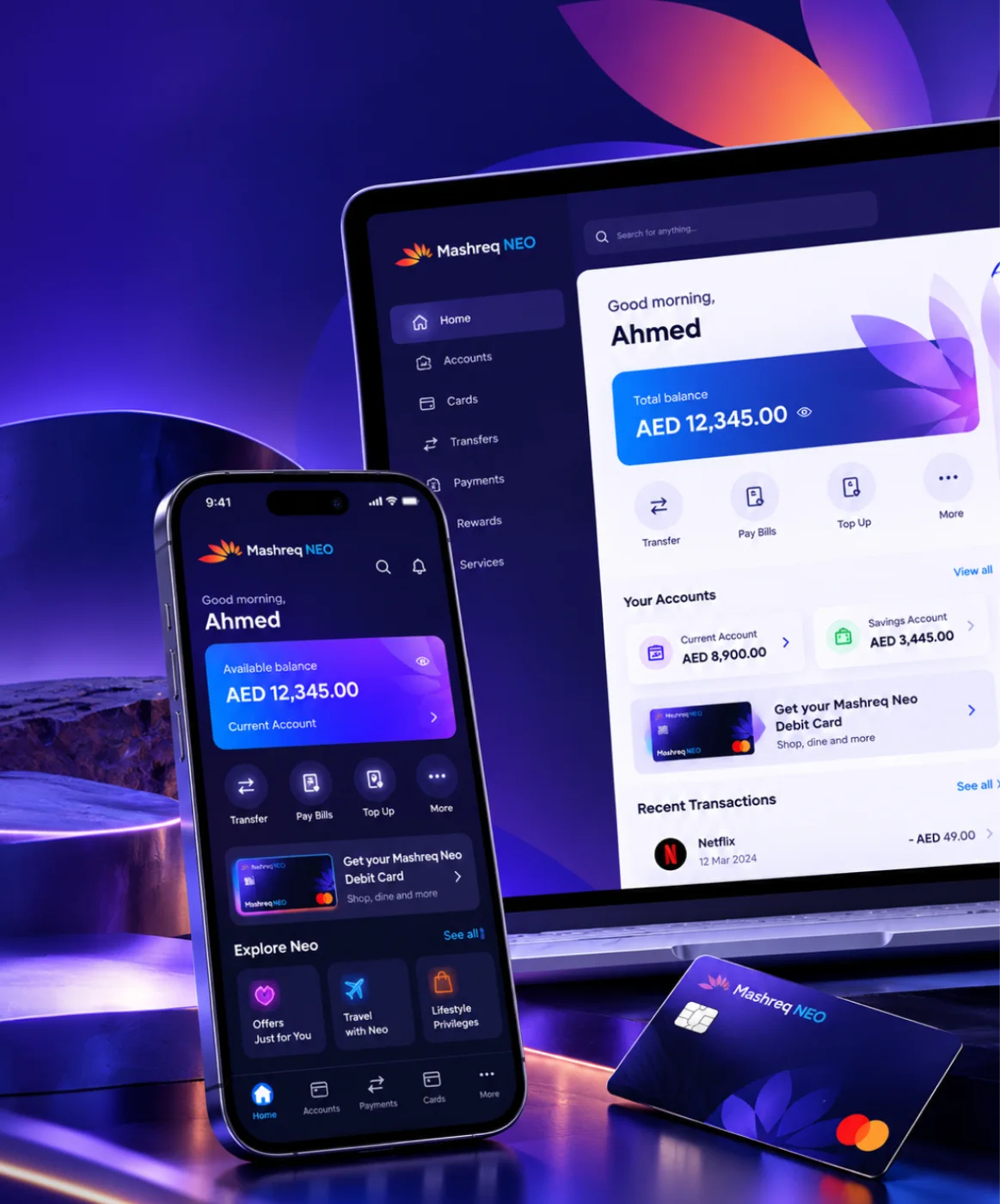
Mashreq NEO
Six performance areas in one index for leadership, plus NEO GPT, a private assistant for bank documents.
Brands For Less
Found where shoppers dropped off, then redesigned sign-up, banners and cart for a retailer with 120+ stores.
Omantel
Incident, SLA and workload reporting in one Power BI suite for Oman’s first telecom operator.




Client Testimonials
Client Success: Panda
We reworked Panda's live app and website, from search to checkout, for shoppers across Saudi Arabia.
"Thanks to UIUX Studio’s work, the client successfully launched their websites. The team maintained a professional approach and scheduled frequent in-person meetings to provide suggestions for improving the project and ensuring its timely delivery."
 Shreya LadCEO, Nutroponics
"The team is well-versed in the UI/UX domain and has designed a fantastic journey to support the site’s growth projection. Communication, timeliness, and quality of work have been very professional."
 Mohammed AbdullahZeaara.com
"The Studio has been an absolute game changer for us. After working on a few independent projects, they are now also helping our marketing team, proving their value to our business and earning praise from executives."
 BrandonProject Manager
"The UIUX Studio team consistently delivers exceptional work with dedication. We’ve completed an amazing app design together, and I’m excited to collaborate with them again in the future."
 Hani Farajvancouverhousefinders.com
"We are really pleased with the work that UIUX Studio team has completed for us in designing a website for a new brand. They completed the designs quickly, took on board changes, and the finished product is very professional."
 AnayaHead of Marketing, Freshminds
"I’ve worked with UIUX Studio team on two projects. They capture the vision and run with it! They create exceptional design! Couldn’t be happier with the quality work and files for my developers."
 Brandon PugmirePresident, Imprint City
 Client Results
Reviewed on Upwork, Trustpilot, Clutch, G2 and GoodFirms





Work With Us
Work with a dedicated design team, a fixed-scope project or hourly support. Every model gives you the same in-house designers and researchers.
Access a dedicated team of UI/UX designers and researchers, on-site or remote, who work alongside your engineers every week.
Get StartedGet clear, upfront pricing for a defined design project, such as product discovery, a mobile app design or a design system.
Get StartedGet design help by the hour, perfect for UX reviews, quick UI fixes, iterative changes or design QA before a release.
Get StartedAll of it is countable, which is unusual for design work and makes this the easiest engagement to hold us to.
Differences between design and build found after release. This is the number the whole engagement exists to reduce.
How often engineering has to ask. Falling counts mean the specs are answering questions before they are asked.
Problems reaching an audit rather than being caught at component level, where they cost almost nothing to fix.
Engineering time spent correcting visual and behavioural defects. Usually the most persuasive figure for a finance conversation.
Share of values coming from tokens rather than hard-coded. Rising coverage means fewer interpretation gaps.
Shorter when nobody is blocked on a question or waiting on a correction cycle.
From retail apps and banking dashboards to a defence group rebrand, we bring proven domain knowledge to every product we design and build.
Talk to Our Team
Streaming, OTT & content platforms

Fan engagement & live data

EdTech & learning platforms

AdTech & campaign tooling

PropTech & marketplaces
Payments, banking & wealth

Digital health & patient apps

Retail & D2C platforms

Supply chain & fleet ops
B2B products & dashboards
This service exists at the seam between design and engineering, so it touches almost everything either side of it.
The system that makes handoff mostly unnecessary, because the components are already specified.
View service ↗The interface work whose quality this service exists to protect through implementation.
View service ↗Where performance and keyboard specs matter most, and interpretation gaps cost the most.
View service ↗Where you need the build as well as the design, done by one accountable team.
View service ↗Forty-five minutes with a designer and an engineer. We will diff them, tell you where the quality leaked and why, and what would have caught it. No deck, no audit fee.
Fix the handoffBook a free consultation with our design, engineering and AI experts. Share your idea and we’ll come back within one business day with clear next steps.
Recognised By


Our Offices

UAE · Headquarters
Office OFF2-127, SMARK 2 Building, Plot No. 33-0, Ras Al Khor Industrial Second, Dubai, UAE

India
B-409, Bestech Business Tower, Sector 66, SAS Nagar, Punjab 160062

Australia
Tapleys Hill Road, Fulham Gardens, SA 5024