








Offshore / Onsite
Hire Dedicated Team
Access dedicated strategists and senior engineers, on-site or remote, who review your plans and stay on call while you decide.
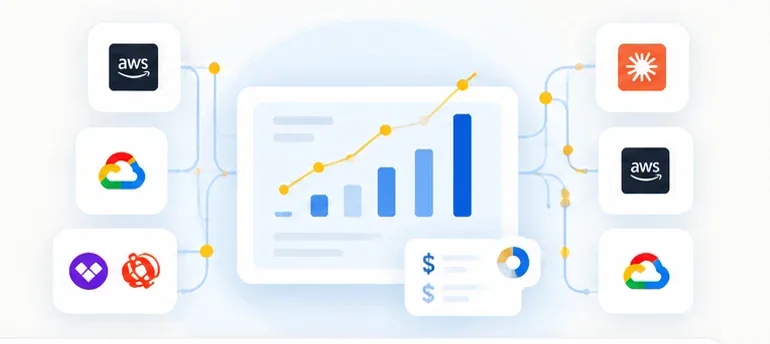
Get StartedCloud cost optimisation and FinOps: waste separated from genuine capacity, commitments and rightsizing quantified, tagging and showback implemented, and savings tracked against the baseline. Most cloud overspend is an architecture and attribution problem rather than a procurement one.
Our Clients

















Cloud spend rarely grows because of one decision. It grows through four mechanisms simultaneously, and none of them are visible on a provider dashboard organised by service type rather than by who caused it.
One invoice, no tags, and no answer to which product, team or customer generated the increase.
Tagging enforced at provision time so untagged resources cannot be created, then per-service, per-team and per-tenant dashboards.
Steady baseline workloads paying on-demand rates because nobody modelled commitment coverage against usage.
Commitment strategy modelled from actual usage patterns, with the flexibility premium priced rather than assumed.
Instances and databases provisioned for a projected peak two years ago and never revisited, running at eight per cent utilisation.
Rightsizing based on measured utilisation with headroom stated explicitly, so the decision is a trade-off rather than a guess.
Cross-zone traffic, chatty services, unbounded retries and full table scans. No procurement negotiation fixes any of it.
The architectural drivers identified and costed, so you know which engineering change moves the bill most.
A model your finance team can re-run and an engineering plan your team can execute, which are usually two different documents forced into one.
Every line of spend mapped to a service, team and where relevant a customer, including the resources nobody claims ownership of.
What is genuinely unused, what is over-provisioned, and what is deliberate headroom. Conflating the three is how savings targets get missed.
Reserved instances, savings plans and instance sizing modelled against real usage, with the risk of over-committing stated.
The design decisions generating the most spend, ranked by what a change would save against what it would cost to make.
Policy enforced at provision time, plus dashboards and budget alerts so cost becomes visible before the invoice.
Actions sequenced by return and effort, with a measurement approach so the saving is verified rather than claimed.
Cloud cost work gets commissioned after a surprise. These are the surprises.
Revenue is up ten per cent and infrastructure is up forty. That gap is almost always architectural.
Gross margin per account is required for a board pack or a funding round and cannot currently be produced.
Reserved instances or a savings plan is ending and nobody has modelled what to renew against current usage.
A lift-and-shift completed and the running cost is higher than the data centre it replaced.
Model usage is now material, growing unpredictably, and attributed to nothing in particular.
Next year’s infrastructure number has to be defensible rather than last year plus a percentage.
Cost work is arithmetic at a volume people cannot sustain: cost and usage reports with millions of rows, dozens of SaaS invoices, licence schedules and infrastructure definitions that all have to be reconciled into one picture. Doing that in days rather than weeks is what makes a two-week review possible, and the saving is in the fee.
Cloud usage reports, SaaS invoices and licence schedules reconciled into cost per service and per team. By hand this is a fortnight nobody budgets, so it goes undone.
Utilisation assessed across the whole estate rather than the largest line items, which is where the long tail of forgotten resources actually lives.
Untagged resources traced to a likely owner from naming, network position and deployment history, then confirmed with the team before anything is changed.
A resource that looks unused may be a disaster-recovery standby or a quarterly batch job. Every deletion and every commitment is decided by a person with the owning team present.
See our AI practiceAn idle resource is a candidate, never a decision. We confirm purpose with the owning team before anything is removed.
A savings plan is a multi-year financial commitment. The model is reviewed and signed by your finance team, not applied by us.
Cost-driven engineering changes follow your normal review and testing process. Saving money is not a reason to skip it.
A shorter review is priced as one, and we charge a fixed fee rather than a share of savings so the incentive stays clean.
Almost every failed cost programme started by cutting before attributing. Without attribution you cannot tell waste from capacity, and the first outage after a cost exercise ends the programme.
Every line of spend reconciled and mapped to a service, team and owner, including the unclaimed resources. This is the artefact everything else depends on.
What is genuinely unused, what is over-provisioned and what is deliberate headroom, confirmed with the teams who own it rather than inferred from a graph.
Reserved capacity and instance sizing modelled against real usage, with the over-commitment risk stated so finance can judge the trade-off.
The design decisions generating the most spend — data transfer, query patterns, retry behaviour, storage lifecycle — ranked by saving against effort.
Tagging enforced at provision time, dashboards and budget alerts live, and a measurement approach so each action’s saving is verified rather than assumed.
Read-only billing and infrastructure access, with the model and dashboards left running in your accounts.





Read-only billing and infrastructure access, with the model and dashboards left running in your accounts.


Read-only billing and infrastructure access, with the model and dashboards left running in your accounts.



Read-only billing and infrastructure access, with the model and dashboards left running in your accounts.


Read-only billing and infrastructure access, with the model and dashboards left running in your accounts.




Case Studies
Selected work for retail, banking, telecom and defence teams, from brand identity and mobile apps to data platforms and AI assistants.
Panda
Reworked search, categories and checkout in Panda’s live app and website, in Arabic and English.
EDGE Group
Brand identity, website and print for a group of 12,000 staff, carried onto the IDEX show floor.
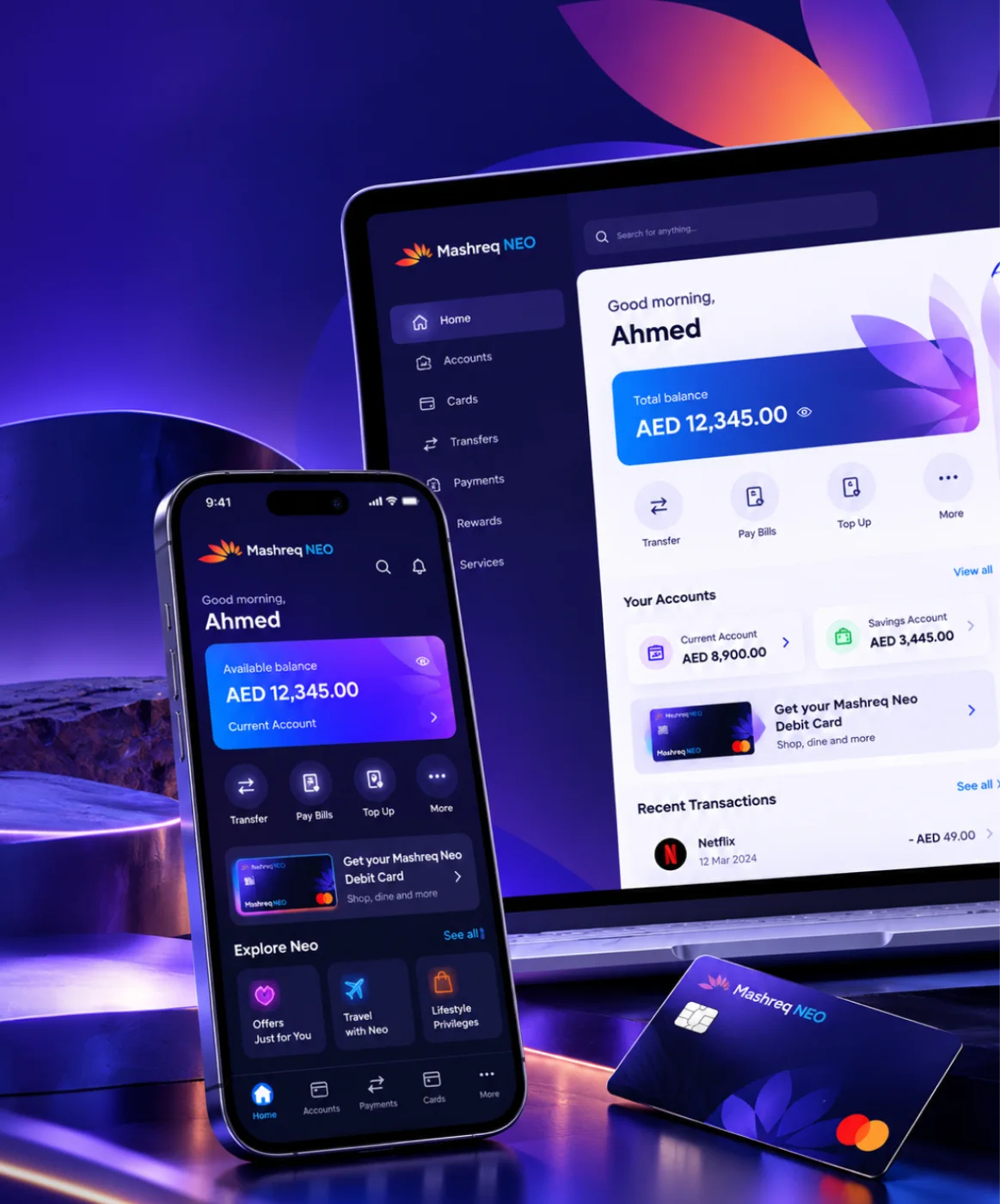
Mashreq NEO
Six performance areas in one index for leadership, plus NEO GPT, a private assistant for bank documents.
Brands For Less
Found where shoppers dropped off, then redesigned sign-up, banners and cart for a retailer with 120+ stores.
Omantel
Incident, SLA and workload reporting in one Power BI suite for Oman’s first telecom operator.




Client Testimonials
Client Success: Panda
We reworked Panda's live app and website, from search to checkout, for shoppers across Saudi Arabia.
"Thanks to UIUX Studio’s work, the client successfully launched their websites. The team maintained a professional approach and scheduled frequent in-person meetings to provide suggestions for improving the project and ensuring its timely delivery."
 Shreya LadCEO, Nutroponics
"The team is well-versed in the UI/UX domain and has designed a fantastic journey to support the site’s growth projection. Communication, timeliness, and quality of work have been very professional."
 Mohammed AbdullahZeaara.com
"The Studio has been an absolute game changer for us. After working on a few independent projects, they are now also helping our marketing team, proving their value to our business and earning praise from executives."
 BrandonProject Manager
"The UIUX Studio team consistently delivers exceptional work with dedication. We’ve completed an amazing app design together, and I’m excited to collaborate with them again in the future."
 Hani Farajvancouverhousefinders.com
"We are really pleased with the work that UIUX Studio team has completed for us in designing a website for a new brand. They completed the designs quickly, took on board changes, and the finished product is very professional."
 AnayaHead of Marketing, Freshminds
"I’ve worked with UIUX Studio team on two projects. They capture the vision and run with it! They create exceptional design! Couldn’t be happier with the quality work and files for my developers."
 Brandon PugmirePresident, Imprint City
 Client Results
Reviewed on Upwork, Trustpilot, Clutch, G2 and GoodFirms





WORK WITH US
UIUX Studio offers flexible technology advisory with a dedicated team of strategists and senior engineers. Whether you need a full technology roadmap or a second opinion on one decision, our engagement models give you independent advice when you need it.
Access dedicated strategists and senior engineers, on-site or remote, who review your plans and stay on call while you decide.
Get StartedGet clear, upfront pricing for work such as an AI readiness review, product discovery or a vendor selection, with set deliverables.
Get StartedGet a strategist or senior engineer by the hour to review an architecture, a vendor or a project plan.
Get StartedTotal spend alone hides growth and efficiency moving in opposite directions. These separate them.
Spend per order, per user or per transaction. The only figure that distinguishes growth from waste.
Share of spend traceable to a service, team and owner. Anything unattributed is named rather than tolerated.
How much of the baseline is on committed rates, and whether those commitments are being used.
Resources genuinely retired, separated from headroom deliberately retained.
Realised saving per action, measured rather than claimed. Projected savings are not savings.
Where it applies, gross margin per account — usually the number finance wanted in the first place.
From retail apps and banking dashboards to a defence group rebrand, we bring proven domain knowledge to every product we design and build.
Talk to Our Team
Streaming, OTT & content platforms

Fan engagement & live data

EdTech & learning platforms

AdTech & campaign tooling

PropTech & marketplaces

Payments, banking & wealth

Digital health & patient apps

Retail & D2C platforms

Supply chain & fleet ops
B2B products & dashboards
Most durable cost saving is architectural, so this engagement frequently hands over to engineering work.
Implementing tagging, dashboards and the architectural changes the review identified.
View service ↗Where the cost driver is a design decision that needs a proper options assessment.
View service ↗Per-tenant cost attribution and the metering a usage-priced product depends on.
View service ↗Where the question is a commitment structure or a platform change rather than optimisation.
View service ↗Forty-five minutes with a platform engineer. We will tell you what the bill is hiding, whether the growth is usage or waste, and roughly where the largest saving sits. No deck, no share of savings.
Review your cloud spendBook a free consultation with our design, engineering and AI experts. Share your idea and we’ll come back within one business day with clear next steps.
Recognised By


Our Offices

UAE · Headquarters
Office OFF2-127, SMARK 2 Building, Plot No. 33-0, Ras Al Khor Industrial Second, Dubai, UAE

India
B-409, Bestech Business Tower, Sector 66, SAS Nagar, Punjab 160062

Australia
Tapleys Hill Road, Fulham Gardens, SA 5024